
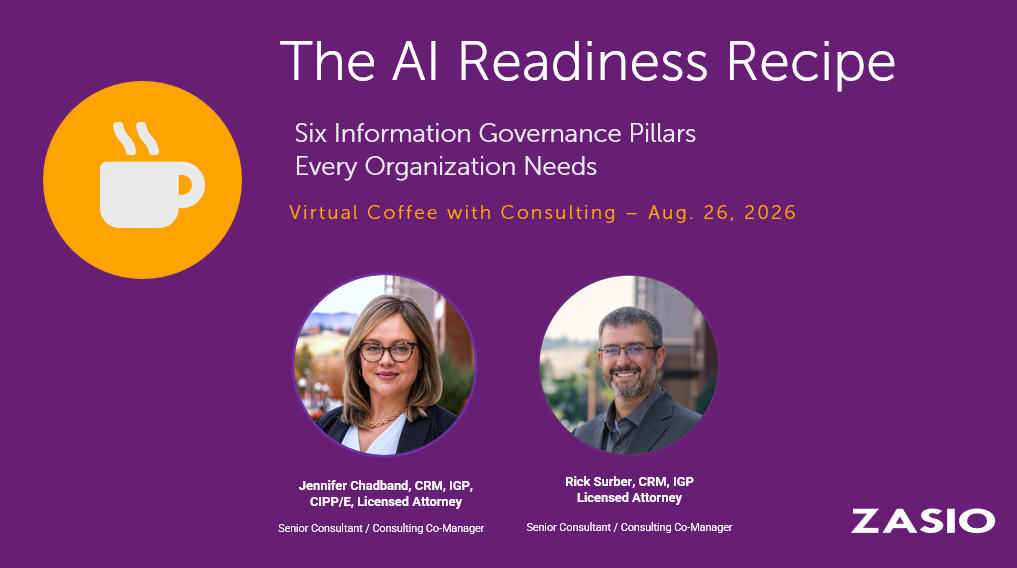
AI records readiness begins long before organizations select a tool, launch a pilot, or invest in a new platform. Successful AI initiatives depend on trusted information, strong governance, and effective records management practices. During Zasio’s Aug. 26 Virtual Coffee with Consulting webinar, senior consultants Jennifer Chadband and Rick Surber explored why information readiness is the foundation of AI success.
Is our information ready for AI?
It’s an important distinction. Across industries, leaders are under pressure to adopt artificial intelligence, launch pilots, and identify new use cases. Yet as Chadband and Surber explained, AI does not magically fix information problems. It amplifies them. If an organization’s information is outdated, duplicated, poorly managed, or difficult to find, AI can spread those issues faster and on a much larger scale.
That reality is reflected in the research presented during the webinar. Only 7% of enterprises say their data is completely ready for AI, while 73% are still struggling to prepare it. At the same time, AI adoption is widespread, but far fewer organizations can point to measurable business impact from those investments.
For records management and information governance professionals, this presents both a challenge and an opportunity. The skills and practices that have long supported compliance, defensibility, and information management are becoming essential to successful AI records management initiatives.
A Simple Recipe for AI Records Readiness
According to Chadband and Surber, AI readiness depends on six interconnected information governance pillars:
- Governance
- Information Quality
- Metadata
- Retention and Disposition
- Technology
- Workforce Adoption
These pillars do not operate independently. They reinforce one another, and weaknesses in one area often create problems elsewhere.
Pillar 1: Information Governance Provides the Foundation
Governance is the recipe itself. It establishes who makes decisions, who owns information, and who is accountable when something goes wrong.
Organizations frequently focus on policies while overlooking decision rights. When a new AI use case emerges, who decides whether it can move forward? Who determines which data the tool can access? Who is responsible if a faulty output leads to a poor business decision?
The good news is that many organizations already have governance structures in place. Information governance committees, records policies, legal hold procedures, and delegation frameworks often provide the foundation needed to manage AI initiatives. Rather than building a separate bureaucracy, organizations can extend existing governance programs to include AI use cases.
Pillar 2: Information Quality Shapes AI Outcomes
AI systems do not automatically recognize the difference between an authoritative document and an outdated draft. A superseded policy, abandoned procedure, or duplicate file can easily be treated as a reliable source if quality issues have not been addressed.
For records and information management professionals, the challenges are familiar:
- Duplicate content across repositories
- Outdated drafts that were never removed
- Orphaned collaboration sites
- Conflicting versions of business documents
- Information that has drifted away from its system of record
These issues have always created risk. AI simply raises the stakes by delivering answers quickly and confidently, whether the underlying information is accurate or not.
Pillar 3: Metadata Delivers Context
Metadata may not receive the attention it deserves, but it plays a critical role in AI readiness.
Without metadata, AI can retrieve content but struggle to understand its significance. A draft document may appear just as credible as an approved version. Obsolete content may be surfaced alongside current information. Sensitive information may not be properly separated from less restricted content.
For the information governance community, this is familiar territory. File plans, taxonomies, classification schemes, security labels, and retention codes have always supported findability and defensibility. In the AI era, they also helped systems retrieve the right information and provide the appropriate context.
Pillar 4: Retention and Disposition Reduce Risk and Noise
Many organizations continue to retain enormous amounts of redundant, obsolete, and trivial content. While this approach may feel cautious, it often creates more risk, more cost, and more confusion. Every outdated record that remains accessible becomes another piece of information that AI can retrieve and present to users.
Retention schedules, legal holds, and defensible disposition remain just as important in an AI-enabled environment as they have always been. According to the webinar, AI does not suspend an organization’s records management obligations. In fact, those obligations become even more important as AI tools gain access to larger information repositories.
Organizations must begin addressing new information assets associated with AI, including prompts, prompt logs, training datasets, model outputs, and related artifacts. These emerging record types require governance and retention decisions of their own.
Pillar 5: Technology Is Not the Starting Point
Technology matters. It just should not come first.
That is why the webinar deliberately placed technology as the fifth pillar rather than the first. Organizations often rush to purchase AI tools before addressing the underlying information environment. When projects fail to deliver value, the technology receives the blame even though the root causes usually lie elsewhere.
The key questions are familiar to anyone who has worked in records management or information governance:
- What repositories can the tool access?
- How are permissions managed?
- What content can be searched for?
- What activity is logged?
- Can the organization demonstrate control through audit trails?
AI does not create new access. It dramatically accelerates existing access. That means long-standing permission problems, over-shared repositories, and stale security groups can quickly become significant risks once AI tools are introduced.
Pillar 6: Workforce Adoption Determines Success
Ultimately, people determine whether governance succeeds or fails.
The webinar described workforce adoption as the baristas and coffee drinkers in the recipe. They are the individuals who decide whether approved processes are followed or bypassed.
This is where many AI programs stumble. Organizations purchase licenses, launch pilots, and conduct demonstrations, only to discover that employees have not meaningfully changed how they work. In other cases, users turn to unauthorized consumer AI tools because the approved solutions feel too cumbersome or difficult to access. The presenters referred to this growing challenge as “shadow AI,” drawing a direct comparison to the shadow IT issues many organizations have dealt with for years.
The solution is not simply more policy documents. Successful programs combine governance with practical training, clear expectations, and user experiences that make the compliant path the easiest path. Records and information governance professionals have spent decades helping organizations navigate behavior change, which makes their expertise particularly valuable in today’s AI initiatives.
The Question Every Organization Should Be Asking
One of the strongest messages from Jennifer Chadband and Rick Surber’s August 26 Virtual Coffee with Consulting session was that organizations may be focusing on the wrong first question.
Before evaluating vendors, comparing features, or approving the next AI pilot, organizations should first assess the state of their information.
- Is governance clear?
- Can information be trusted?
- Is metadata providing meaningful context?
- Are retention and disposition practices working as intended?
- Does technology support appropriate controls?
- Are employees equipped to use AI responsibly?
Those questions sit at the heart of AI records readiness. No single pillar stands alone. A weakness in one area inevitably appears as a problem somewhere else.
The encouraging news is that organizations do not need all six pillars to be perfect before they begin their AI journey. Readiness is a maturity process, not a launch date. The goal is progress, not perfection. Organizations that focus on strengthening their information governance foundations today will be far better positioned to realize meaningful value from AI tomorrow.
Disclaimer: The purpose of this post is to provide general education on records management and information governance software. The statements are informational only and do not constitute legal advice. If you have specific questions regarding the application of the law to your business activities, you should seek the advice of your legal counsel.