
Drowning in Legal Updates? How to Successfully Wade Through it All
Your retention schedule management software is likely busy, sending continuous updates. Managing a records retention schedule with a substantive jurisdictional footprint can be an onerous and dreaded task; managing the U.S. alone involves thousands of citations. Managing an international schedule may have you constantly chasing legal updates across dozens or even hundreds of federal and sub-jurisdictions. With every single change you are having to decide whether it affects your organization.
At some point you have to level with yourself and determine whether you or your team has the bandwidth and expertise to review all this research. Should this fail, it isn’t an indicator of your capabilities. Instead, this is a signal your current process cannot address the volume. The following guidance will help you build a research review process that separates the updates that matter from the ones that do not.
Not All Updates Are Created Equal
In general, most legal updates fall into one of three categories.
No impact
The citation changes, but the regulated party, record, and retention period do not. These updates are non-substantive and very common: a citation suffix changes when a statute is renumbered, or a law is amended with a revised title that changes the heading. In essence, the requirement is amended in a way that leaves the retention period and its scope unchanged. These updates matter for the integrity of your citation library and as the foundation of due diligence for your retention schedule, but they do not require a change to your schedule.
Indirect impact
Under this scenario, the requirement may have changed, but not by enough to drive a change to your retention period. For example, if the global baseline retention period for a record series is 10 years and a change to a citation extends that jurisdiction’s requirement from 5 years to 7 years, the change would not affect the schedule because the global baseline still covers it. In that situation, the update is potentially impactful, but it does not move the dial for the schedule’s established retention periods.
Direct impact
The change influences an established retention period in your policy by changing the current recordkeeping requirement, adding a new requirement that requires longer retention, or introducing a maximum retention period that requires shorter retention. Failure to address these types of changes can lead to under-retention or over-retention, either of which creates a compliance problem.
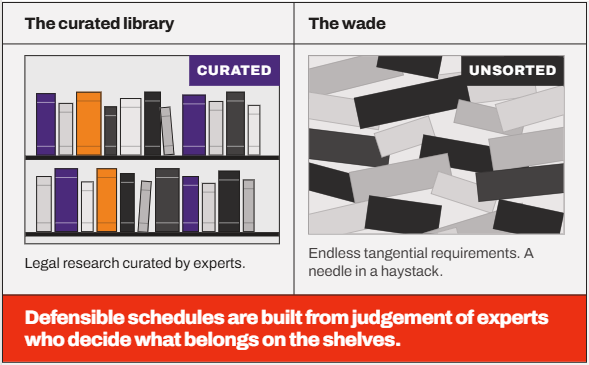
This last category is where your focus should be. In my experience, it is the smallest by volume, but with the right approach, it does not have to be the needle in the haystack.
An Impact Assessment Process
When a legal research update arrives, consider the following before deciding whether to act:
- Does the jurisdiction apply to us? Consider where your organization’s regulated activities take place.
- Is the regulated party relevant? Who is the regulated entity? If it is an employer, there’s a good chance it applies. But if it is an energy provider, for example, the requirement may only apply if you are a utility provider.
- Does it change the retention period? A new citation supporting an existing period is a citation library update and does not require a schedule change. Likewise, a revision such as a suffix change is non-substantive and would not drive a change.
- If the period changed, does our current baseline still satisfy it? Longer requirements and new maximum requirements are almost always impactful. Shorter requirements rarely require immediate action, though they may be relevant from a data minimization perspective when assessing the overall adequacy of established retention periods.
- Are there privacy implications? Over-retention of personal information carries its own risk, independent of the recordkeeping requirement. Aligning retention periods generally to both minimum and maximum recordkeeping requirements helps guard against this. Staying mindful of trends in retention periods, even when they do not drive an immediate change, is good practice.
A good research solution should provide a way to pre-filter or sort citation updates so many of these steps can be handled in bulk. Additional support from a records management expert can further reduce the amount of hands-on review your team needs to perform.
Where Outside Research Support Fits
The ease of this process depends heavily on the state of your research database. Good recordkeeping research curation happens upstream, during the research process itself, when every citation entering the database is selected and customized by someone who understands why it belongs there. This makes the five questions above much easier to answer. Research built to that standard takes legal depth most records management teams are not staffed to maintain in-house.
Zasio’s in-house team of records management and legal experts has researched more than 300 countries, states, territories, and municipal jurisdictions, building a research base of over 181,000 substantive citations. That depth is what makes curation possible in the first place, because you cannot reliably distinguish a low-impact requirement from a consequential one without understanding the framework it sits in. Zasio’s analysts focus on research that matters, cut out the noise, and help you identify the updates that matter to your organization more quickly.
That curated research flows directly into Zasio’s Versatile software platform, which is designed to help successfully manage the complete lifecycle of your records.
Conclusion
If you are reading this, you are likely already aware that the answer to a rising tide of legal updates is not to process more of them faster. The solution is to establish a trusted process and pair it with research support that helps your team focus on the updates that matter.
Think of Zasio’s Versatile research database less like an open-web search result and more like a curated reference library: every citation is selected, verified, and shelved where you can find it, by records management and legal experts who know why it belongs there. The Versatile platform and Zasio’s legal research were built for this because these days, volume is easy to come by while judgment is less so.
Whatever your process, it is essential to lean on research expertise you can’t reasonably build yourself. The updates will keep coming either way, but with a reliable process in place, you will find yourself wading instead of drowning.
Zasio customers can visit the customer portal for a tutorial: Zasio Customer Portal. The Versatile 2026 Research tab provides additional guidance.
Disclaimer: The purpose of this post is to provide general education on records management and information governance topics. The statements are informational only and do not constitute legal advice. If you have specific questions regarding the application of the law to your business activities, you should seek the advice of your legal counsel.