
From Digitization to Disposition: Transforming Your Legacy Paper Records
The digital era has made practicing Records and Information Management (RIM) easier in many ways. But the digital era cannot account for one thing: the legacy paperwork many organizations have carried with them throughout the years.
Legacy hard copy records often pile up, untouched and forgotten. The adage ‘out of sight, out of mind’ is dangerous when applied to these records. They carry just as much risk as your digital records, are subject to the same retention and privacy obligations, and are just as discoverable. But digitization often means a structural overhaul that will cost time, space, and money. However, there are strategies to help.
What is Digitization?
Digitization is the capturing and converting of an analog physical record into a digital or electronic system, typically by scanning or taking photographs of items that cannot go through a scanner, such as bound volumes, oversized drawings, and fragile originals. The result is a fixed image of the record, usually stored as a PDF/A or TIFF file, that can be made searchable by applying optical character recognition (OCR).
Starting Digitization
So, your organization has decided to digitize. Where do you even begin? Before deciding on a methodology or strategy, you should be able to answer some basic questions:
- How many physical records do we have?
- Where are these physical records stored?
- What types of paper records do we have and what is the physical condition of these records?
- How old are these physical records?
- How often are these physical records requested or retrieved?
- Why are we keeping these physical records?
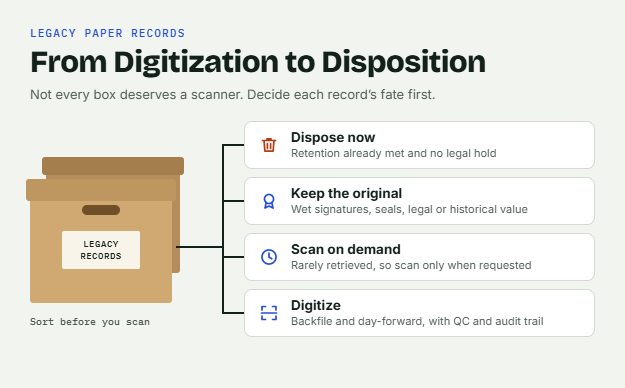
- Which of these records have already met their retention period and can be disposed of now, without ever being scanned?
- Which of these records are subject to a legal hold?
- Which of these paper records must be kept in their original form because a law, regulation, or contract requires it, or because the original has evidentiary or historical value?
Having a comprehensive understanding of what physical records are being kept (and why) takes time but will make digitization much easier.
Digitization Frameworks
Digitization is more than just sifting through old papers and letting memory or emotion guide what gets scanned. There are three common approaches to deciding what gets transformed digitally:
Backfile Conversion
Backfile Conversion is the systematic digital transformation of an existing body of legacy papers and files, prioritizing them by retention obligations, legal holds, and historical value.
Day-Forward Conversion
Day-Forward Conversion addresses records from a set cutoff date forward. After that date, every paper record created or received is captured digitally at or near the point of creation or receipt, under a documented procedure, so the legacy backlog stops growing.
Scan on Demand
You will most likely never retrieve a good portion of your legacy paper records. Scan on Demand cuts down on the cost of digitization by keeping paper records until they are requested, which is when they are scanned. Otherwise, they stay as a hard copy through their retention period, which is when they are disposed of.
These frameworks are not mutually exclusive, and you can use more than one if needed throughout the digitization process. Perhaps your organization implements Day-Forward Conversion first so new paper records are handled properly before scanning legacy records with Backfile Conversion. While a methodology is necessary, it’s also important to stay adaptable.
Whether you use one (or all) of these frameworks, what follows are some ideas and considerations for further implementing the digital transformation of your paper records.
Record Series and Retentions
The two main driving principles behind digitizing legacy records are their retention length and frequency of retrieval. If there are legacy paper records that have already met their retention periods pursuant to your records retention schedule (and don’t have a legal hold), they can be disposed of. And if there are records that have a remaining retention, you can sort them based on what records justify the cost of scanning versus leaving them in paper form for the duration of their retention.
Historical Legacy
When digitizing, you will want to locate and identify what legacy paper records hold importance for your organization. These records should be treated with care, especially if they are older and in fragile condition. If these hard copy records have permanent or historical value (founding documents, contracts, board meeting minutes), consider archival storage with proper conservation. Handling requirements in the law sometimes require certain document types to be stored in paper format, and there can also be requirements surrounding documents with wet signatures or seals. In the U.S., the E-SIGN Act and the Uniform Electronic Transactions Act generally allow an accurate, accessible electronic copy to satisfy a records-retention requirement, but there are exceptions (such as wills and certain negotiable instruments), so confirm before you scan and shred. Long-term proper storage is appropriate for these record types.
Validation and Quality Control
Quality control and a proper audit trail are what make your digitization efforts defensible. It is imperative that these processes be implemented before you scan your first record, for digitization is only as good as your quality control. There should be set standards to ensure that everything scanned is readable, attachments and annotations are logged, and page counts match. Use indexing to log the metadata of each scanned record to ensure it’s findable. Scan records in batches to inspect a sample, correct if needed, and dispose of records only if their batch has passed quality inspection.
An audit trail is the record of the project itself, and answers the who, what and where behind the digital transformation and disposal of each paper record. Create a chain-of-custody log that shows which records were scanned, who scanned them and when they were scanned, and use certificates of destruction to capture every record that is disposed of. You will need to show what batches passed inspection, what facility or office records were received from, and how your paper records stacked up against your quality control methodology. That way, when a discovery request comes asking for a certain paper record, you have an answer.
Disposition and Destruction
One of the payoffs of a digitization project is disposing of the paper records that are no longer needed. However, before you turn the shredder on, confirm that your retention schedule and policies recognize the scanned image as the official record copy, so the digital version carries the remaining retention period. You should also be aware of legal holds and destruction requirements:
Legal Holds
A legal hold is implemented if there are records that need to be retained for ongoing discovery, anticipated litigation, audits, and government inspection. A hold overlays the retention schedule: held records are not a separate record series, but they cannot be disposed of until counsel releases the hold. If there are any legal holds in place that impact paper records, they must be retained. You will need to collaborate with your legal counsel to ensure these records are handled properly.
Destruction Requirements
As with recordkeeping requirements, destruction requirements are often built into the letter of the law. It’s important to confirm any handling requirements before destroying paper records. Destruction requirements can include the secure destruction of personal information, or the burning or pulverizing of certain records. As with legal holds, you should be working with your legal counsel to ensure compliance.
Defensible Digitization
Whether your organization has 50 boxes of paper records or 5,000, the strategies shared can assist in your digitization efforts. The benefits of digitization include more office space, less anxiety about paper records, and becoming more environmentally conscious. But these perks are trumped by the true end goal of digital transformation: to create a defensible and compliant records program that you and the rest of your organization can be confident in.
At Zasio, we specialize in creating defensible records programs, with expertise in how your organization can digitize. Let Zasio Consulting lead the way for more ideas and strategies on digital transformation.
Disclaimer: The purpose of this post is to provide general education on records management and information governance topics. The statements are informational only and do not constitute legal advice. If you have specific questions regarding the application of the law to your business activities, you should seek the advice of your legal counsel.