
The Global Ripple Effect of the EU AI Act’s Retention Mandate
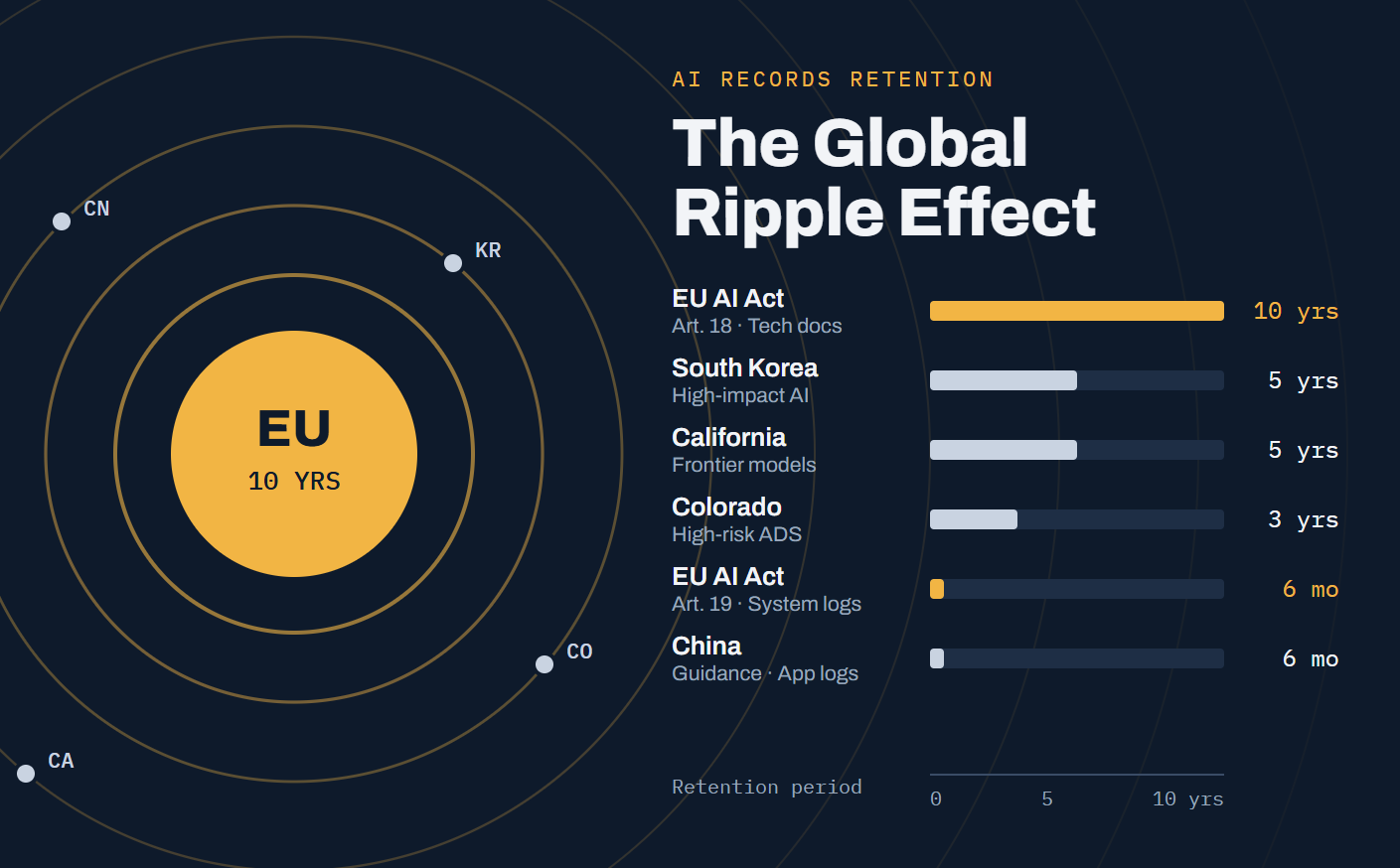
In 2024, the European Union introduced a 10-year retention requirement for documentation supporting high-risk AI systems. Since then, China, South Korea, California, and Colorado have adopted their own AI recordkeeping requirements.
For records and information management professionals, this reflects a growing trend. AI accountability is becoming a records retention issue. Regulators generally agree that organizations should be able to show how their AI systems work and how decisions are made. The main difference is how long those records must be kept. Organizations that develop, sell, or use AI should understand which requirements apply and how long supporting records must be retained.
The EU Sets a Two-Tier Retention Standard
The EU AI Act creates two distinct retention obligations for high-risk AI systems. Under Article 18(1), providers must retain technical documentation for 10 years after the system is placed on the market or put into service.1 Separately, Article 19 requires automatically generated logs to be retained for at least six months.2
Together, these requirements create a two-tier retention framework. Technical documentation helps show that the system was designed and developed to meet regulatory requirements. System logs help show how the system operates.
Other Countries Follow
China’s AI Security Governance Framework is non-binding guidance that recommends keeping AI application logs for just 6 months.3 South Korea’s Enforcement Decree under its Framework Act on AI Development provides that records related to high-impact AI systems must be kept for 5 years.4
In the United States, AI recordkeeping requirements are starting to appear at the state level. California and Colorado have taken different approaches. California requires developers of frontier AI models to retain records of sensitive information removed from public safety reports for five years.5 Colorado, by contrast, adopted SB 26-189, which requires organizations to keep compliance records related to high-risk automated decision systems for three years, beginning January 1, 2027.6 A court challenge delayed enforcement of the earlier law, but the new bill remains on track.7
Same Goal, Different Approaches
While these laws differ in scope and retention periods, they ensure organizations maintain records that demonstrate compliance for their AI systems. Retention periods currently range from 6 months to 10 years. Some requirements are broad and cover technical documentation for an entire AI system, such as those in the EU AI Act. Others are much narrower, such as California’s requirement to retain information removed from public safety reports. Organizations that operate across multiple jurisdictions may need to follow several AI retention requirements at the same time.
What This Means for Your Program
Start by identifying the AI systems your organization develops, buys, or uses, and the jurisdictions where they operate. This helps you determine which retention requirements apply to each system without trying to track every AI law around the world. When multiple retention requirements apply to the same AI system, many organizations use Article 18(1) of the EU AI Act as their global baseline. The 10-year retention period is longer than most current AI retention requirements and can help support compliance across multiple jurisdictions.
A Trend Worth Watching
The EU AI Act did more than create new rules in Europe. It created a framework that other jurisdictions are beginning to adapt to their own needs. As AI regulations continue to evolve, additional recordkeeping requirements are likely to follow. As AI retention requirements continue to emerge, organizations should incorporate AI governance into their existing records and information management programs. Retention obligations are becoming a standard feature of AI regulation. Organizations that build AI recordkeeping into their retention schedules today will be better prepared as new requirements arise.
Disclaimer: The purpose of this post is to provide general education on records management and information governance topics. The statements are informational only and do not constitute legal advice. If you have specific questions regarding the application of the law to your business activities, you should seek the advice of your legal counsel.
- Regulation (EU) 2024/1689 (Artificial Intelligence Act), art. 18(1). ↩
- Regulation (EU) 2024/1689 (Artificial Intelligence Act), art. 19. ↩
- Artificial Intelligence Security Governance Framework, Version 2.0. ↩
- Framework Act on the Development of Artificial Intelligence and the Establishment of a Trust Foundation, art. 34(1); Enforcement Decree, art. 27(2) (Presidential Decree No. 36580). ↩
- Cal. Bus. & Prof. Code § 22757.12(f). ↩
- Colo. SB 26-189 (2026). ↩
- X.AI LLC v. Weiser, No. 1:26-cv-01515-DDD-CYC. ↩